
Jefferson County Deed Types and Their Research Uses
A document label is a first clue, never a final answer. Jefferson County deed records can reflect an ordinary sale, a family or estate transfer, a correction, a partial interest, or some other conveyance entirely. Read the granting language and the legal description before assuming any instrument transfers the same rights as the next one.
| Instrument | What to inspect | What not to assume |
|---|---|---|
| Warranty or bargain-and-sale deed | Grantor, grantee, description, consideration language, prior reference | That no separate lien or exception exists |
| Quitclaim deed | Interest actually released and named parties | That a full fee interest changed hands |
| Executor or administrator deed | Estate authority, parties, probate context | That the deed alone explains every heir |
| Correction deed | Original reference and corrected term | That the earlier filing should be ignored |
| Transfer-on-death material | Current statutory form and later recording | That a beneficiary already owns the parcel |
The latest grantee is a strong ownership lead. Confirmation still requires the full instrument, plus a check for later deeds, corrections, estate documents, or court filings that could change the picture.
Search Jefferson County Deed Records Through IQS
The County Clerk points researchers to the Jefferson County IQS entry. It covers deeds, mortgages, maps, judgments, and other indexed holdings. The landing page offers guest search, subscription, account, and login routes. The dynamic query form, though, does not render outside the live system. Verify the exact dropdown names, export tools, and earliest online index year there. Do this before relying on any of them.
- Start with the full name of a recent owner from the proper assessment roll.
- Search both grantor and grantee roles and test name variants.
- Narrow by a known date, municipality, parcel clue, or deed book and page when available.
- Open the image and record the execution date, recording date, legal description, and prior reference.
- Check the index again for later instruments affecting the same parties or parcel.
Name hits are index leads, nothing more. Similar names, initials, company variants, and spouses mean the parcel description and chronology must carry the match.
Jefferson County Clerk Deed Access Beyond the Portal
A failed online search is not proof that no deed exists. In-person searching is free during business hours. The Clerk confirms this at 175 Arsenal Street in Watertown. Researchers can also use the records-search request for a mail search. That form asks for the record category and names. It also needs the year or search period, requester details, and delivery information. Call 315-785-3312, option 2, when the needed series or request type is unclear. The County Clerk search and copy page documents these access choices.
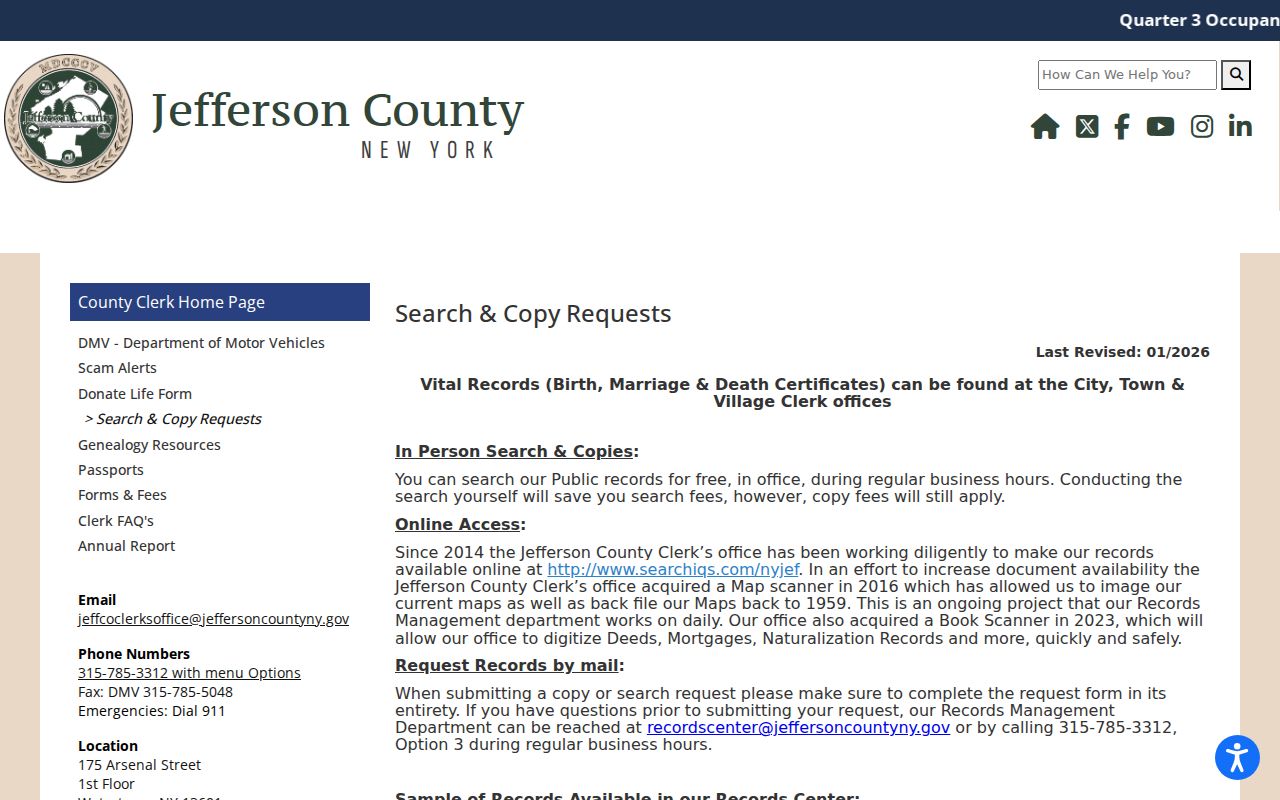
The page confirms the online, counter, and mail fallback chain that should accompany every Jefferson County deed search.
How Far Jefferson County Deed Records Reach
The Clerk's historical inventory identifies deed holdings beginning in 1793. That date describes the collection, not the IQS online cutoff. Online index and image coverage varies by series. The earliest searchable year in the current IQS interface is best confirmed there. For an older chain, turn to the historical deed books, indexes, microfilm, or the staff-assisted request. The Clerk describes that request process.
Coverage distinction. Jefferson County's deed collection begins in 1793, but the earliest year available in the current online index was not confirmed.
Older handwriting, shifting town boundaries, reused family names, and descriptions keyed to adjoining owners can all slow the work. Preserve the exact book, page, and index spelling at every link. A modern tax-map number rarely appears in an early deed, so the legal description and the adjoining-owner trail often beat an address.
Read a Jefferson County Deed Before Citing It
The index locates the instrument; the image supplies the evidence. Record the grantor, grantee, deed type, execution date, acknowledgment, recording date, book and page or instrument number, stated consideration, property description, prior deed reference, signatures, and any schedule or exception. Note whether the deed covers the whole parcel, several parcels, or only an interest.
Grantor is the transferring party. Grantee is the receiving party. Vesting describes how an interest is held, a legal description identifies the land in the instrument, and a deed reference points to another recorded document without being the full chain itself.
Never turn the tax-roll mailing address into the deed's property description. Mailing address, situs, postal city, tax parcel, and legal description are separate fields, and they may legitimately differ.
Build a Jefferson County Chain From the Latest Deed
Start with the newest confirmed deed, not merely the newest name on a roll. Identify its grantor. Search that grantor as a grantee in an earlier acquisition. Then repeat the process, checking dates and descriptions at every step. This backward walk builds a working chain. It also exposes gaps that call for older books, maps, probate records, or court files.
| Chain step | Evidence to retain | Cross-check |
|---|---|---|
| Current conveyance | Grantee, recording date, description | Current roll and parcel map |
| Prior acquisition | Earlier grantee who became later grantor | Prior reference in deed |
| Parcel change | Exception, split, lot, or filed map | Subdivision map and later lot deeds |
| Estate or court event | Fiduciary or proceeding reference | Surrogate's Court or eCourts route |
A chain assembled this way is not a professional title search. It can expose missing links and guide copy requests. Marketable title may still require a title professional and records beyond the deed index.
Jefferson County Deed Filing Forms and Checks
The Clerk's deed information sheet lists original-document, address, acknowledgment, tax-form, transfer-tax, fee, and return-mail requirements. It references forms such as TP-584, RP-5217, and IT-2663 when applicable. The exact forms depend on the transaction. Check current instructions before submission. Do not copy from an older closing file. The official County Clerk forms hub is shown here.
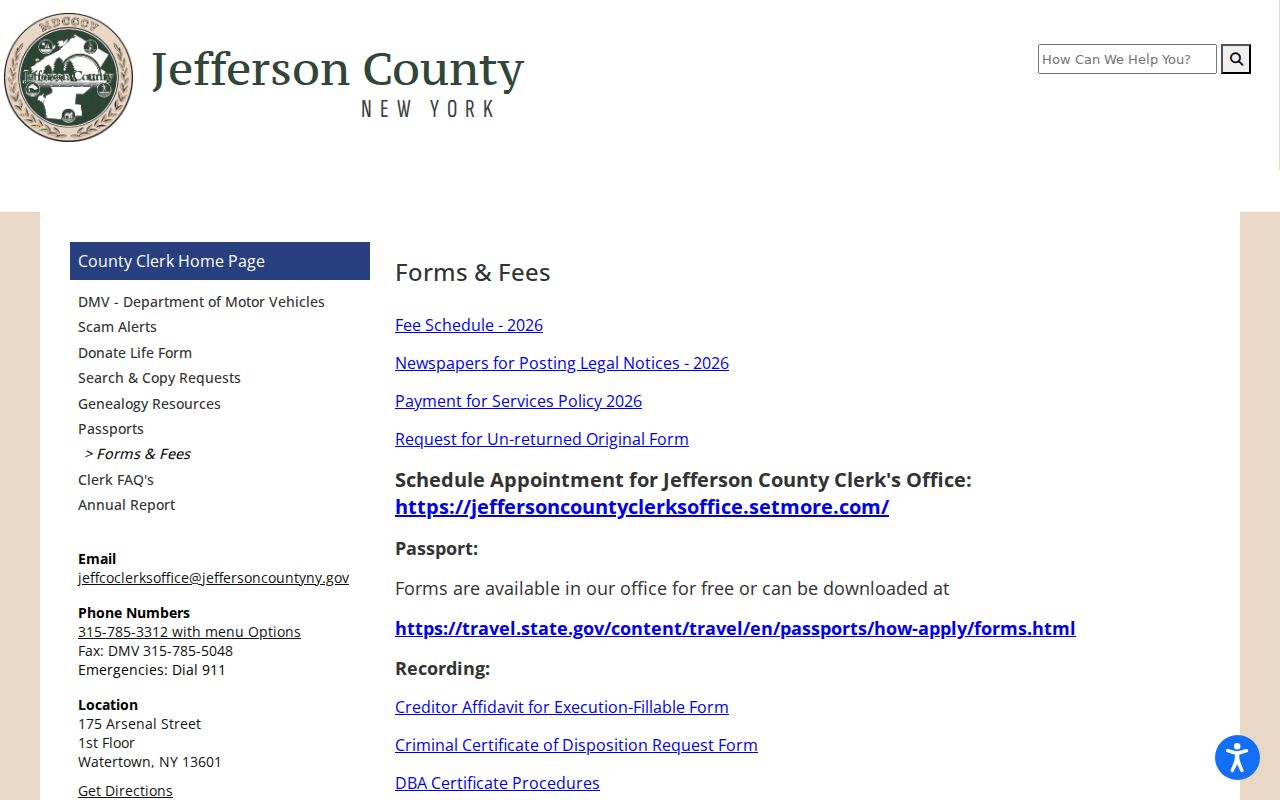
That sheet provides a direct route to the current deed checklist and fee schedule. It also covers the search form and related land-record materials.
Subdivision filings carry their own requirements. The county sheet addresses planning timing, a tax search, survey affidavit, map size, certifications, filing timing, and a stated $10 map fee. A planning approval or GIS polygon alone does not prove a proposed lot was conveyed. Inspect the recorded map and the later deeds.
Jefferson County Deed Copies, Fees, and Certification
The fee schedule covers a lot of ground. Recording charges sit beside per-page rates for regular and certified copies. Minimums and maximums apply. Name-based search charges are listed too. You will also find map items, judgment and lien items, UCC filings, and paid guest periods on IQS. Figures shift over time. Before ordering, confirm every amount against the current linked schedule. State whether you need an ordinary copy, a certified copy, or another product.
Payment rules matter too. The schedule lists United States currency, cash, checks or money orders, and major cards subject to conditions. A self-addressed stamped envelope, or the stated postage, gets your documents returned. A precise request cuts staff search time. So give party names, record type, date range, book and page if known, property location, and contact details.
Recording Alerts for Jefferson County Deed Names
IQS offers a name-based Fraud Alert service. The form takes Jefferson County, an email address, and up to ten personal or company names, with separate first and last name fields and account-management controls. Any alert is only a prompt. It asks you to inspect a filing, not to treat it as a ruling on validity or fraud. The official Fraud Alert enrollment form handles signup in one place.
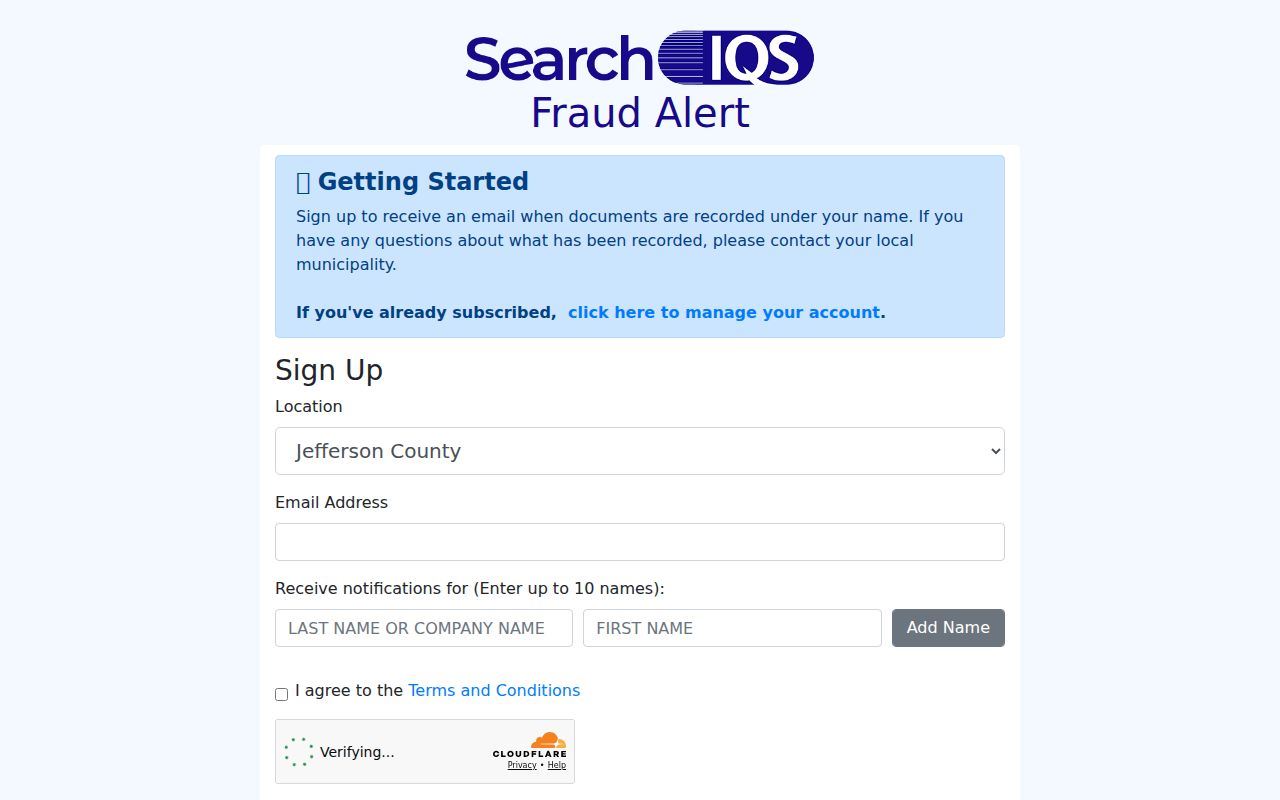
The official enrollment form shows the names and email workflow.
Resolve City and Town Names in Jefferson County Deeds
A Watertown mailing address settles nothing. You still have to confirm whether the land sits in the City of Watertown, the Town of Watertown, or another municipality. Check the tax map, SWIS, legal description, and roll. The City runs separate assessment and GIS systems, and county rolls list towns without placing the City among them.
History adds its own puzzles. Watertown records may mention Factory Village, Factory Square, Juhelville, Huntingtonville, North Watertown, wards, or old street numbers. Flower Memorial Library's guide explains the 1907 address change and why the 1908 directory helps. Old names help you find the right deed. They never replace the recorded description.
Limits of a Jefferson County Deed Search
A recorded deed shows a filed conveyance. It cannot prove every lien was released, that an online boundary is exact, or that a signer held undisputed authority. Court or probate problems can cloud title too. When a question demands more, search mortgages, releases, judgments, lis pendens, maps, and the relevant court records.
Verify before relying. Jefferson County deed records support property research, but a records search is not a title opinion or boundary survey.
Keep names and mailing data to lawful property research. Keep private details out of anything you publish. Never turn a deed search into a tool for stalking, harassing, threatening, or targeting a person. For a certified legal conclusion, rely on the records custodian, a title professional, a surveyor, or an attorney suited to the issue.