
Build a Jefferson County Former-Owner Timeline
Scattered deed hits become a testable chain once you lay them on a timeline. Open the newest deed image and move back one transfer at a time. Before an index name goes into the chain, the parcel description and the dates must show it belongs to the subject land in Jefferson County. Similar names are the main hazard here. Check the parcel description first. Then confirm the dates place the transfer with the subject land in Jefferson County. Similar names are the main hazard here.
| Transfer date | Grantor to grantee | Instrument | Book/page and check |
|---|---|---|---|
| Newest confirmed filing | Latest grantor to recorded grantee | Deed type as labeled | Compare parcel and current roll |
| Prior acquisition | Earlier owner to the later grantor | Earlier deed | Follow prior reference and description |
| Parcel-formation event | Parent tract to lot owner | Deed plus filed map | Confirm lot, exception, split, or merger |
| Estate or court transfer | Fiduciary or authorized party | Executor, administrator, or court-linked deed | Check probate or court context |
Where evidence is missing, leave a blank or a research note instead. A visible gap is more honest than a guessed predecessor, and it marks the exact point where the next deed search should resume.
Walk Jefferson County Previous Owners Backward
Treat the latest deed's grantor as your next grantee search. When that earlier acquisition surfaces, confirm its description covers the same parcel before adding it to the chain. Keep repeating the step until you reach the target period or the trail enters material the online index does not cover.
- Confirm the latest deed image, parties, recording date, and property description.
- Search the grantor as an earlier grantee, allowing for initials and name variants.
- Compare acreage, lot number, adjoining owners, and prior references.
- Record intervening corrections, quitclaims, estate deeds, maps, and partial interests.
- Move to historic indexes or a Clerk request when online coverage stops.
This reverse-index method is what actually answers the former-owner question in Jefferson County. One isolated deed copy documents a single transfer, not the chain of title behind it.
Search Jefferson County Former Owners Through the Clerk
The Jefferson County Clerk points researchers to IQS. IQS holds deeds, mortgages, maps, judgments, and other indexed material. IQS offers guest and account routes. The search form is dynamic. Its current fields and earliest online year should be confirmed live. Name roles, date filters, image access, and export options can shift. The official County Clerk search and copy instructions fill in the request details.
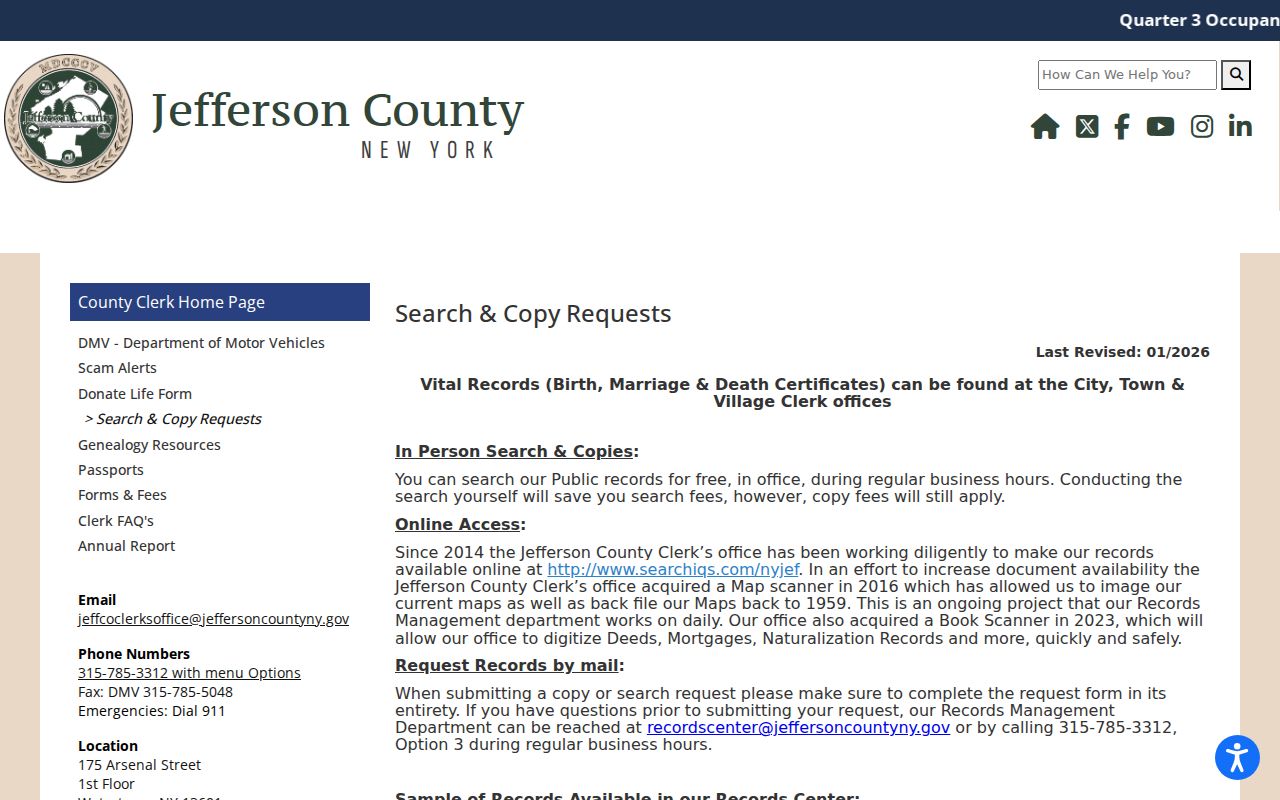
That page lays out the fallback chain. It covers online research, free in-person searching at the Clerk's office, and a mail search request, in that order. The mail form takes a record category, names, a year or period, contact details, and delivery preferences. A sharper request helps a great deal. Give the municipality, property location, parcel number, and any known book and page from the deed records.
How Far Jefferson County Ownership Records Go
The Clerk's inventory lists deed holdings beginning in 1793. That date describes the historical collection, not the IQS cutoff. Older former owners of Jefferson County land may call for handwritten grantor and grantee indexes and bound deed books. They may also call for microfilm, maps, or staff-assisted research. Treat 1793 as the archive's starting point. Never treat it as a promise of universal online deed records.
Online limit not confirmed. The historical deed collection starts in 1793, while the earliest searchable online year remains a documented research gap.
Older records can cite former town boundaries, hamlet names, or adjoining owners. A modern street number may be absent entirely. Preserve the exact spelling and citation even when a later Jefferson County source standardizes the name.
Terms Used in a Jefferson County Ownership Chain
Clear terms keep a name list from masquerading as title analysis. A deed may transfer all of a parcel, part of it, or only a claimed interest. The instrument's own text controls, not the shorthand label.
A grantor transfers an interest. A grantee receives it. The chain of title is the linked sequence of conveyances touching the same land, while a reverse index sorts searches by the opposite party role. A quitclaim passes only the grantor's stated interest, which is not the same protection as a warranty deed.
"Former owner" should mean a party backed by the relevant conveyance and parcel evidence. A former taxpayer is not automatically an owner. Neither is a mortgage borrower, adjoining owner, occupant, or mailing contact without the deed records to match.
Use Parcel Descriptions to Separate Similar Owners
Jefferson County names repeat. Companies shift punctuation and suffixes, too. Match a result through the municipality, legal description, tax-map parcel, lot or map reference, acreage, and prior deed citation, because the assessment roll's book and page can bridge a search even when it lags the newest filing.
An older deed rarely carries a modern tax-map number. Compare the parent tract instead: road, watercourse, monuments, adjoining owners, subdivision lot, and later references. A GIS map orients this work. It cannot prove an old metes-and-bounds line follows a current polygon.
A split or merger needs separate chain branches. Do not force every old tract owner into the history of every child parcel without evidence of which land each conveyance included.
Maps and Subdivisions in Jefferson County Former-Owner Research
A recorded subdivision map can pin down when a parent tract became numbered lots in Jefferson County. A $10 map fee applies. The Clerk's requirements cover timing, map size, certifications, and companion items like the survey affidavit, planning record, and tax search, and those rules can change. Check them before filing or ordering. The Clerk forms hub gathers that paperwork.
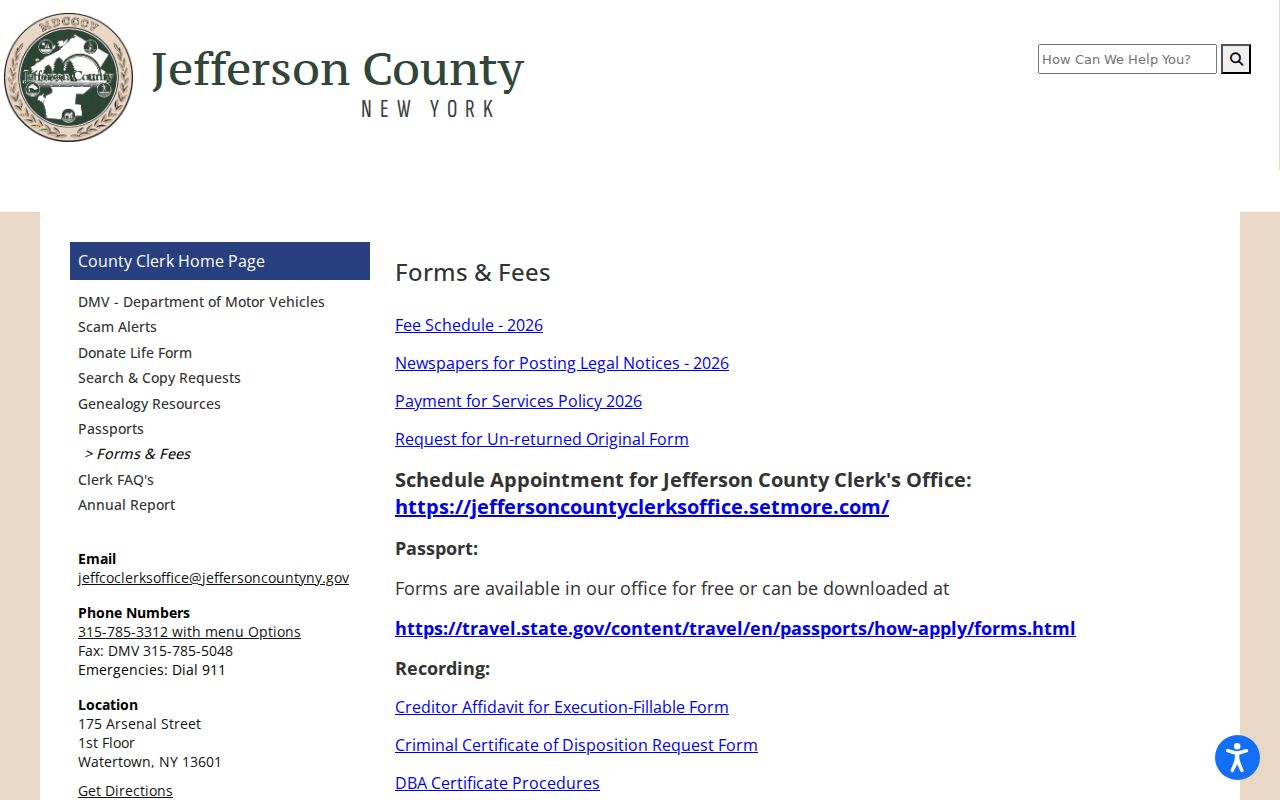
That hub points to the official map and deed materials a Jefferson County chain needs when it crosses a parcel-formation event. A proposed subdivision is not a filed map. A filed map, in turn, does not prove every lot was conveyed, so follow the later lot deeds to see which former owners the record actually supports.
Estates and Court Events in a Jefferson County Chain
A tidy deed-to-deed chain rarely survives every life event. Death, probate, foreclosure, judgment, and divorce can all interrupt the sequence. When one appears, search the deed index for fiduciary instruments first. Then turn to the right custodian. That may be Surrogate's Court, eCourts, NYSCEF, a judgment index, or a lis-pendens filing. County agencies say plainly that they keep no official court files. A general county FOIL request cannot replace the court that actually holds the record.
An estate transfer deserves careful dating. Line up the death or probate date and the deed execution date. Add the recording date, the roll year, and the next assessment update. An estate name can show up on a roll before a beneficiary appears anywhere else. It can also show up well after. The instrument and the court record explain the legal transition. The roll only shows the assessor's dated entry. So read the two together rather than trusting either alone.
Historic Watertown Addresses and Prior Owners
Watertown's 1907 address change can quietly break an ordinary street search. A house numbered under the old system simply vanishes from modern tools. Flower Memorial Library's guide recommends the 1908 directory as a crosswalk between old and current numbers, and adds newspapers, earlier directories, census material, maps, and deeds. Search both numbering schemes and keep whatever evidence links them.
Old references may point to Factory Village, Factory Square, Juhelville, Huntingtonville, North Watertown, a ward, or a neighborhood name. Treat these as clues, not as present assessment municipalities. Public Square's 1805 land history, the 1849 fire, later construction, and the City's 1869 formation all explain why a parcel chain needs several dated sources. A building history and an ownership chain are related projects but not the same project.
Photographs from the Historical Society or old newspaper stories can tie a person or business to a place. Occupancy and association, however, are not ownership. Confirm every former owner through the recorded deed chain itself.
Check Former Owners Against Dated Assessment Rolls
Assessment rolls help bridge recent years. They print a current-owner field plus a deed reference. County town rolls sit apart from the City of Watertown final roll. The City's Image Mate timing statement says owner and sales information updates daily. It reflects deeds filed within three working days. That rule applies to the City only, not to towns. The county tax-roll index appears below.
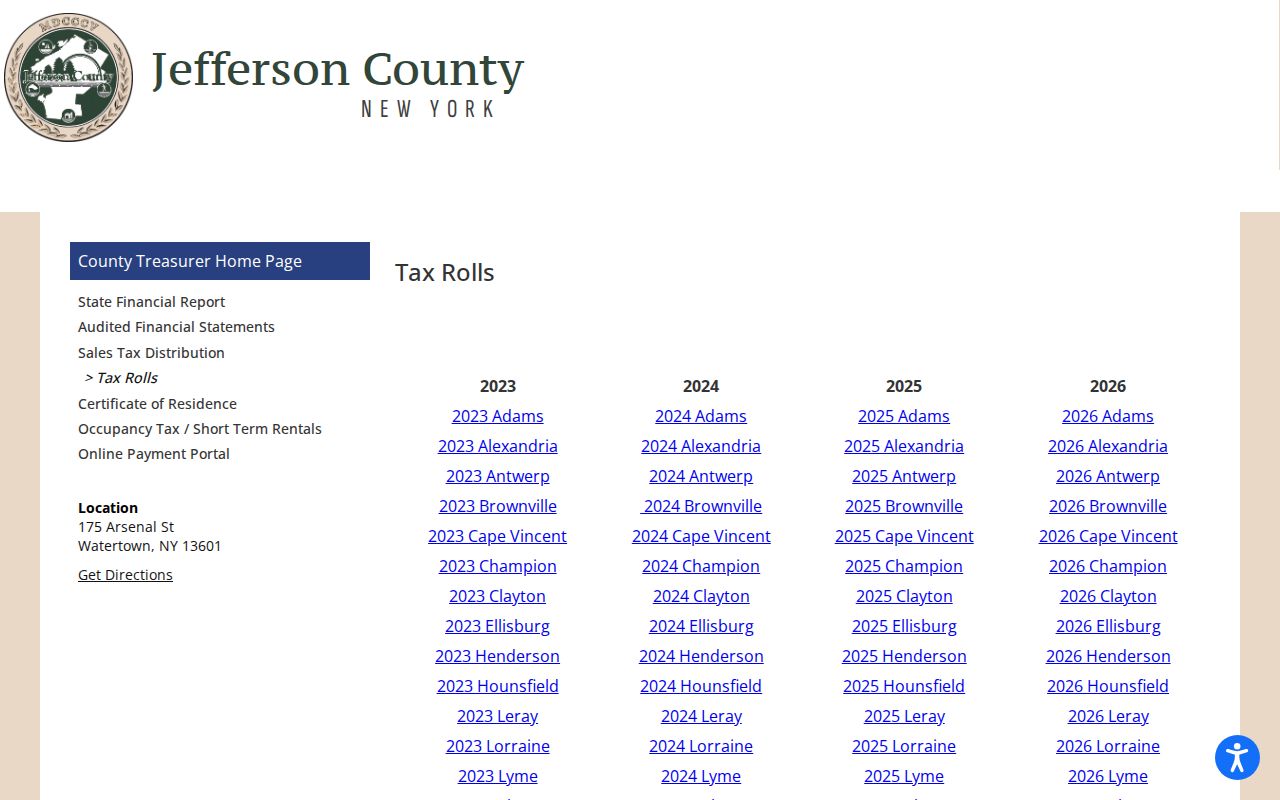
The county tax-roll index page lets a researcher place a recent former owner in a dated roll. City records stay on their separate route. A roll difference may reveal timing rather than an error. Keep the old owner field and the source year together. Add the newer deed and the recording date too. Do not overwrite one source.
Limits When Naming Jefferson County Former Owners
Every research chain has edges. An online index may start late, a description may have changed, a parcel may have split, an estate may have intervened, or the key record may sit with a court. State the gap plainly and name the next official source. Never convert a likely connection into a verified owner of record.
Research, not a title opinion. A backward deed chain supports history and due diligence but does not guarantee marketable title or identify every interest.
Publish only what the property question requires. Mailing addresses, family relationships, and historical identity clues deserve careful handling. Never use former-owner details to harass, threaten, or target anyone. Legal ownership questions beyond the public-record trail belong with a title professional or an attorney.