
Fields in Jefferson County Property Tax Records
One roll row carries a lot: parcel identity, valuation, exemptions, districts, and the tax figures built on them. Check the column label and roll year before trusting any number. A full market value is not a sale price, and relabeling it as one leads people wrong.
| Tax-roll field | What it records | Research caution |
|---|---|---|
| Tax-map parcel and location | Assessment identifier and situs text | Keep municipality and punctuation |
| Current owners name and address | Dated owner and mailing fields | Mailing is not occupancy; confirm deed |
| Property class and land description | Assessment classification and parcel notes | Not a zoning decision or legal description |
| Assessment | Local assessed amount | Use the valuation and roll year |
| Exemptions and taxable value | Adjustments for listed taxing purposes | County, municipal, and school figures can differ |
| Full market value | Equalized value printed on the roll | Not an appraisal or recorded sale |
| Special districts and taxes | District entries and levied amounts | Current balance may require the collector |
A good record card keeps the exact labels intact.
Find Jefferson County Property Tax Records
Start by placing the parcel. Is it in the City of Watertown, the Town of Watertown, another town, or a village? A postal city and ZIP prove nothing about taxing jurisdiction. The tax map, SWIS code, legal description, and roll heading settle the question.
- Open the county tax-roll index or the separate City assessment route.
- Select the proper year and municipality.
- Locate the parcel by tax-map number, property location, or supported search method.
- Copy owner, mailing, class, assessment, exemption, taxable, full-market, deed, and district fields.
- Use the appropriate collector for a current bill or balance and the assessor for valuation questions.
Save the roll year plus the page or source URL whenever you copy a row. A dated screenshot can mislead later, since a new deed or assessment cycle may have changed everything in between.
County-Published Jefferson County Town Rolls
The county publishes recent town rolls covering 2023 through 2026 on its tax-roll page. Watertown City is absent from that list for a simple reason. It keeps a separate system. Treat the gap as routing, not as proof that City property tax records are missing. The official Jefferson County tax-roll index appears below.
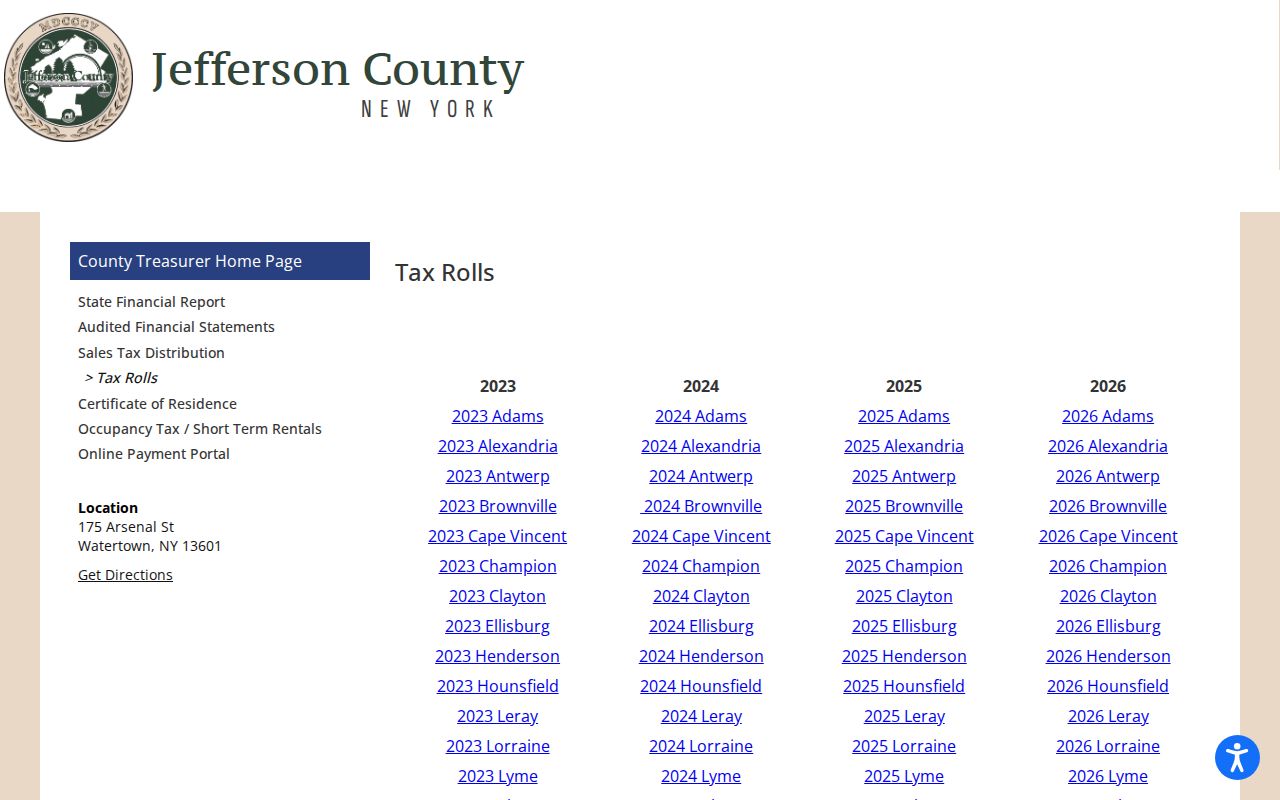
The county route serves towns. City parcels branch off separately.
A Town of Watertown roll row shows the fields that matter: parcel, location, class, current owner, owner address, dimensions, coordinates, deed book and page, assessment, taxable values, and full-market value. A Watertown mailing address does not put a town parcel into the City workflow.
City of Watertown Property Tax Record Branch
The City assessor sits at 245 Washington Street, reachable at 315-785-7760 and assessment@watertown-ny.gov. The City runs Image Mate, GIS, annual final rolls, and its own assessment calendar. Its 2025 final roll uses SWIS 221800 and prints a 073.00 uniform percentage. The City GIS and assessment-search page is shown below.
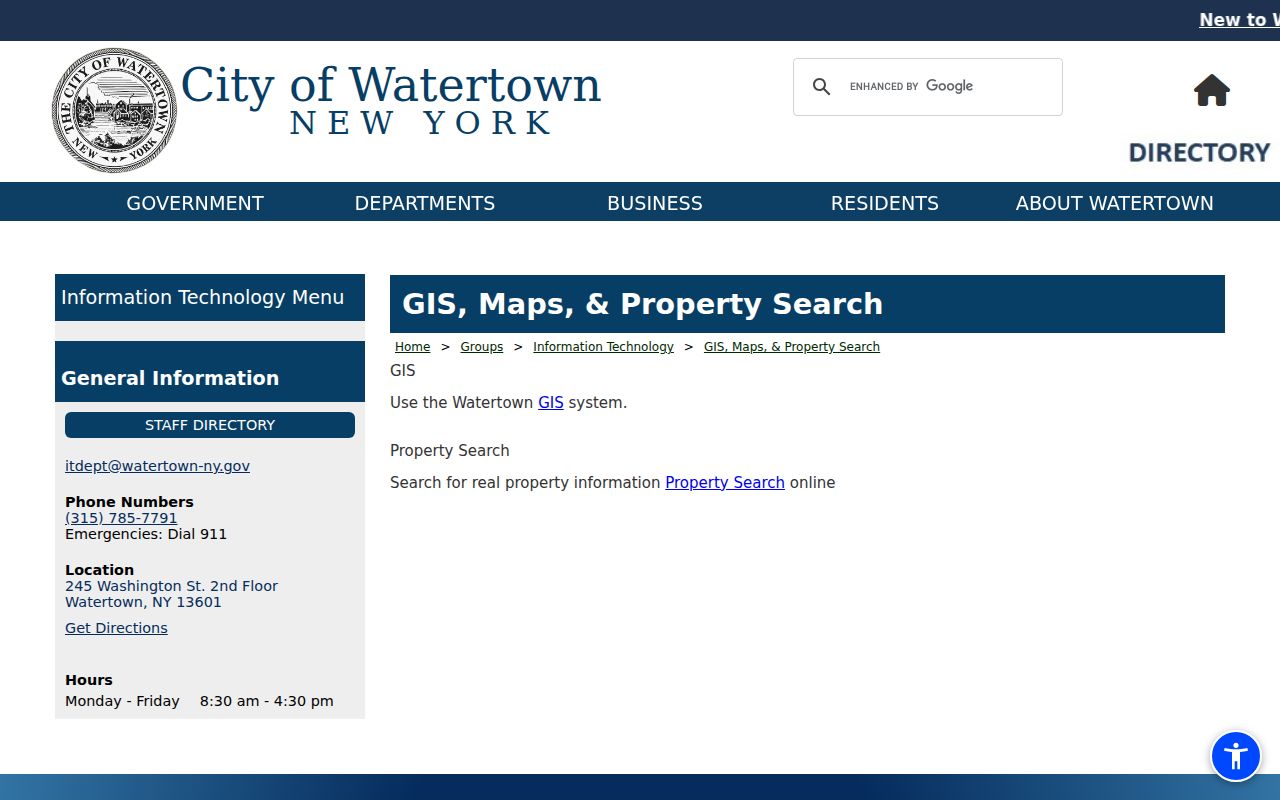
City parcels belong on the City branch, not the county town-roll list.
City Image Mate states that owner and sales data update daily and reflect deeds filed within three working days. That timing applies to the City alone. The annual roll stays a dated snapshot. A current tax balance may require a separate collection source.
Assessment, Taxable, and Full-Market Values
Assessed value is the local assessment on the roll. Taxable value folds in exemptions or adjustments for a particular taxing purpose. Full-market value is the roll's equalized estimate. Sale consideration lives in the deed, transfer record, or supported sales report. Each measure answers a different question.
Assessment ratio, or uniform percentage, relates assessed value to the roll's full-value framework. An exemption cuts taxable value where the program applies. The tax levy is the amount raised. A tax rate works only within its jurisdiction and year. Sale consideration is never inferred from a roll value.
The City's 073.00 figure belongs to the 2025 roll alone. Carrying it into another municipality or year without checking that roll invites error, since county equalization and local practices shift.
Jefferson County Assessment Calendar
The county calendar separates valuation date, taxable-status date, tentative roll, grievance period, final roll, and later appeal steps. Each milestone controls what can be fixed and when. Follow the calendar for the assessing unit involved. Paying a bill is not the same as accepting every assessment fact.
| Stage | Why it matters | Primary contact |
|---|---|---|
| Valuation date | Sets the property condition and value point | Local assessor |
| Taxable-status date | Controls status and exemption context | Local assessor |
| Tentative roll | Provides the review-stage assessment | Assessor and grievance process |
| Final roll | Publishes the completed annual roll | Assessing unit and county resources |
| Administrative or court review | Addresses supported challenges after local steps | Appropriate review body |
Take current dates from the official calendar for the year in question. A prior-year schedule should never be reused automatically.
Owner and Deed Fields in Jefferson County Tax Rolls
A tax roll's current-owner field is a strong starting point. It is not final proof of title. County and town rolls refresh annually, while the City updates more freely. Use the roll's deed book and page to pull the County Clerk instrument. Then look for later deeds or corrections. The County Clerk search and copy page appears below.
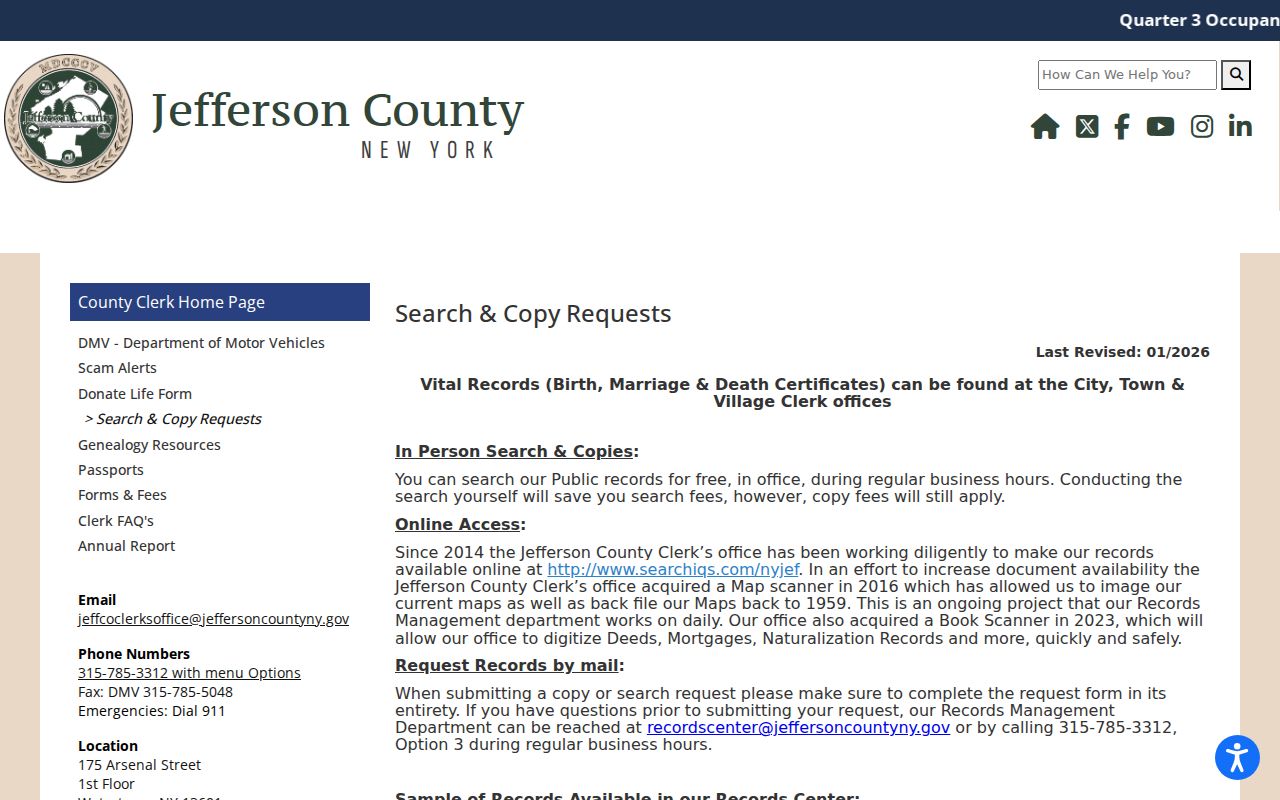
When a tax-roll owner needs checking, the deed settles it.
Line up roll year, valuation date, taxable-status date, and deed execution date. Add recording date and access date. Keep both official entries. Timing, an estate, a trust, a correction, or the wrong municipality may explain the difference.
Exemptions in Jefferson County Property Tax Records
Exemption codes in Jefferson County property tax records do not land on every levy. Treatment varies from levy to levy. County, municipal, and school taxable amounts each carry their own fields. A single exemption may reduce one column and leave another untouched. Read the roll columns instead of assuming uniform treatment. Eligibility on a dated roll is no promise of renewal in a later cycle. So treat each year on its own terms.
Keep the value before exemptions separate from the taxable values that follow. That distinction matters when you compare two parcels or two years side by side. Questions about eligibility, application documents, residency standards, filing deadlines, or corrections belong with the applicable assessor. Follow the current official program guidance. An exemption code describes the parcel, never a person's private circumstances. Report only what the public roll labels. Report what the property question needs.
Current Bills and Delinquent Jefferson County Taxes
A roll and a current bill are different records. The assessment roll fixes assessed and taxable information for its cycle. The collector then applies the levy. That office keeps payment and balance details. Search the correct municipal, school, or other collection route, and note the bill year. A displayed unpaid amount says nothing reliable about an owner's finances. Installment rules, interest, returned payments, corrections, and recent transactions can all shift the status. For a closing or another time-sensitive purpose, ask the collector directly. Request a payoff or current balance from that office.
Foreclosure, lien, and judgment questions can reach beyond the tax page. They reach into County Clerk and court sources. A deed-only search or a tax-only search cannot establish that a parcel is clear of every encumbrance. So widen the record set before drawing conclusions.
Sales Reports and Jefferson County Tax Comparisons
Jefferson County publishes monthly and annual sales reports with property-class codes. The material reaches back to 2010. Comparison work holds up only when municipality, class, date, and transaction type line up. The files carry no complete field dictionary. Rely on the visible labels in whichever report you open. Recorded consideration can also differ from full-market value, assessed value, and a later appraisal. Family transfers, partial interests, estate transactions, and unusual deed types may not represent open-market sales at all.
Read the deed and the transfer context before calling a transaction comparable. When the question is valuation meaning rather than tax-bill procedure, keep each number's source and date attached to it. Blending every figure under one label of property value hides the purpose the public record was built to serve.
Request Missing Jefferson County Tax Material
A roll or GIS record may not be online. Contact the local assessor or County Real Property Tax Services. The county GIS-data request form handles custom reports, mailing labels, and historical assessment material. It also covers mapping fees and delivery details. A strong request names the municipality, parcel, property location, year, desired fields, format, and purpose. New York FOIL covers agency records. These are records not already served by a dedicated assessment, tax, or GIS process. It cannot override exemptions or move court files into county-agency custody. A narrow, record-specific request moves faster than a demand for everything about a property.
Limits of Jefferson County Property Tax Records
Tax and assessment records document administrative values, owner fields, exemptions, districts, and levies for stated dates. They do not guarantee ownership, establish a surveyed boundary, or replace a current payoff from the collector. Nor do they supply a market appraisal.
Verify the record. Use the correct municipality, roll year, and collector, and confirm important owner facts with the latest recorded deed.
Jefferson County property tax records are public information, and that access comes with responsibility. Use them for lawful property research only. Avoid publishing a property owner's mailing address or exemption details when those facts serve no real purpose. Never use tax records to harass, threaten, shame, or single out a person. Assessment disputes belong with the county assessor or its review body. Legal questions call for a qualified adviser.