
What Jefferson County Property Value Numbers Mean
Every value lookup begins with one question: which figure is this? A single parcel in Jefferson County can show several correct numbers, because each serves a distinct administrative or transaction purpose.
| Value type | What it means | Where it is recorded |
|---|---|---|
| Assessed value | Local value placed on the assessment roll | Applicable City or town roll |
| Taxable value | Value remaining for a taxing purpose after listed exemptions or adjustments | Assessment or tax roll columns |
| Full-market value | Equalized estimate printed by the assessment system | Annual roll |
| Recorded sale consideration | Amount or consideration language associated with a transfer | Deed, transfer material, or official sales report |
| Appraised value | Opinion produced for a stated purpose and date | Professional appraisal, not the public roll |
A citation for a Jefferson County property value should name the type, source, municipality, date, and amount. A bare dollar figure tells you almost nothing.
Look Up a Jefferson County Assessed Value
Know which branch assesses the parcel. The City of Watertown assesses on its own. It maintains an assessor, Image Mate, final roll, and GIS. Jefferson County's pages publish the town rolls, including the separate Town of Watertown, and a postal city or ZIP never marks an assessment boundary.
- Confirm the City, town, or village through the tax map, SWIS, or legal description.
- Open the roll or official assessment route for the correct year.
- Locate the parcel by exact tax-map number or verified property location.
- Copy assessment, taxable, exemption, full-market, class, and owner fields with their labels.
- Record the roll year, valuation context, and source URL.
When a portal stalls, fall back on the published roll and the assessor's office. Never paper over an official gap with an unlabeled number.
Jefferson County Town Property Values
A Jefferson County town roll can carry a lot in one row: tax-map parcel, property location and class, current-owner fields, land description, dimensions or coordinates, deed book and page, assessment, taxable values, special districts, taxes, and full-market value. It is a snapshot. Each roll ties to the assessment calendar for its year. Use the Jefferson County tax-roll index below to reach the right town.
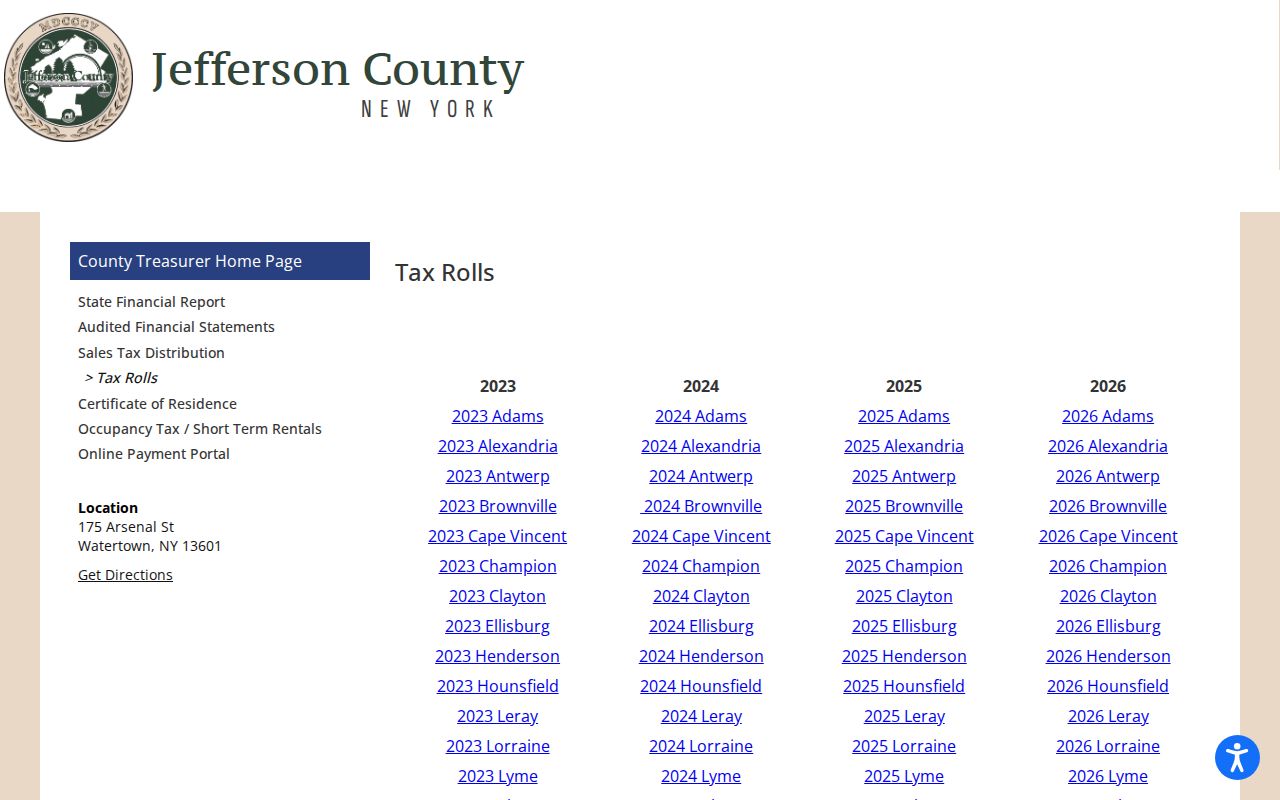
The county's town route covers the towns. The City of Watertown is not part of it; that city's values sit in a separate system. A Town of Watertown parcel shows why labels matter. Its roll prints a full-market figure alongside the assessment and deed reference. None of that makes the number a recorded sale price.
City of Watertown Property Value Fields
Watertown's 2025 final assessment roll carries SWIS code 221800 and a uniform percentage of 073.00, a figure tied to that roll and year. Each row packs in a good deal. You get location and property class, assessment and exemption amounts, taxable values, land and total figures, owner of record data, deed book and page, and full-market value. For maps and parcel detail, the City of Watertown posts its GIS and assessment page as the official starting point.
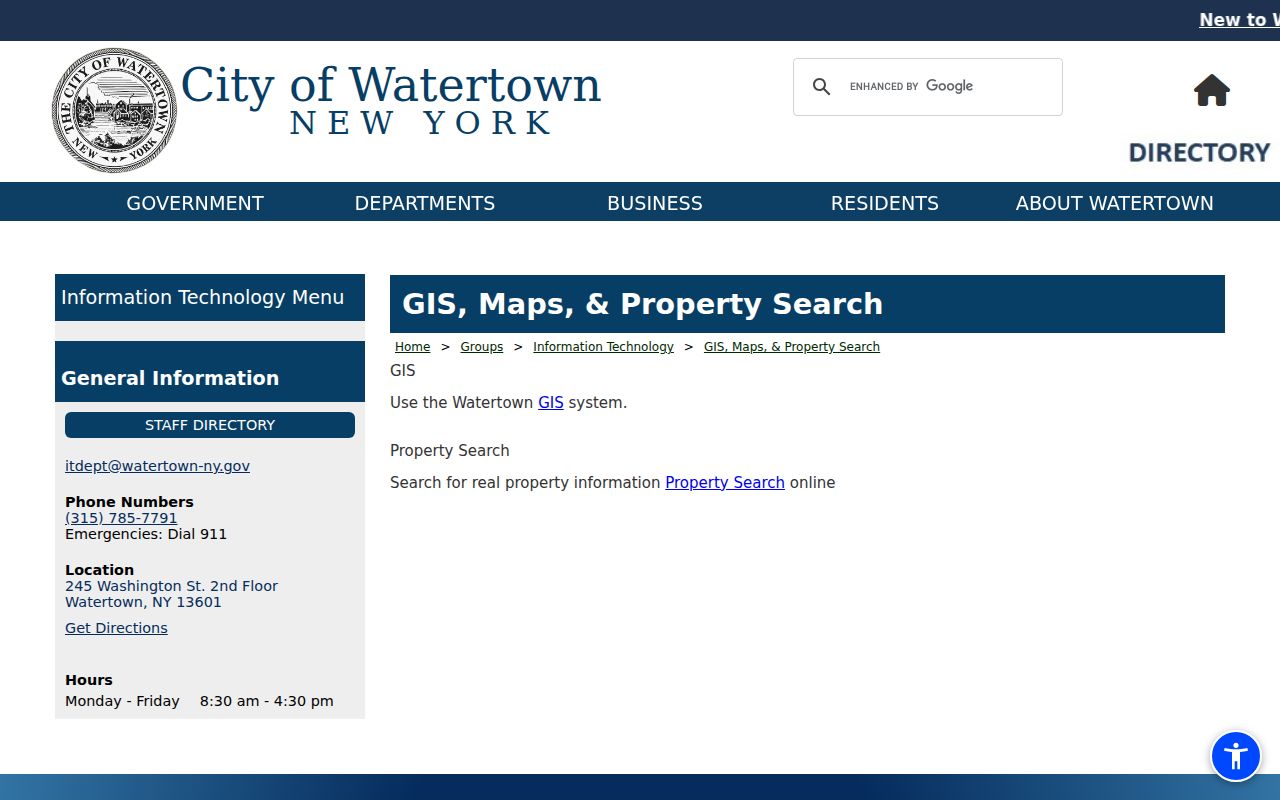
The City keeps its own value lookup. A 2025 example at 933 Academy Street shows a $74,600 total assessment. That sits against a $102,200 full-market value. Those figures describe the assessment relationship on that dated roll. They say nothing about today's sale price or current ownership.
Assessment Ratio and Jefferson County Value Math
An assessment ratio ties the assessed figure to full value. It is not a discount. Nor does it predict appreciation or guarantee a sale price, so use the percentage printed for the applicable municipality and roll year.
Assessed value is the local roll figure. Full-market value is the equalized estimate the assessment system displays, and assessment ratio relates the two for that roll. Reassessment refreshes the roll's valuation work. Sale consideration comes from a transfer source, never from assessment math.
Roll conventions and rounding can leave small gaps in a hand calculation. Cite the printed figures.
Recorded Sale Price Versus Jefferson County Assessment
Deeds and official sales reports are the right home for recorded consideration. The County Clerk's IQS route handles deed research. Jefferson County sales reports add monthly and annual material with class codes back to 2010. Field layouts vary between files. So read the exact fields in the report you open. Start at the County Clerk search and copy page.
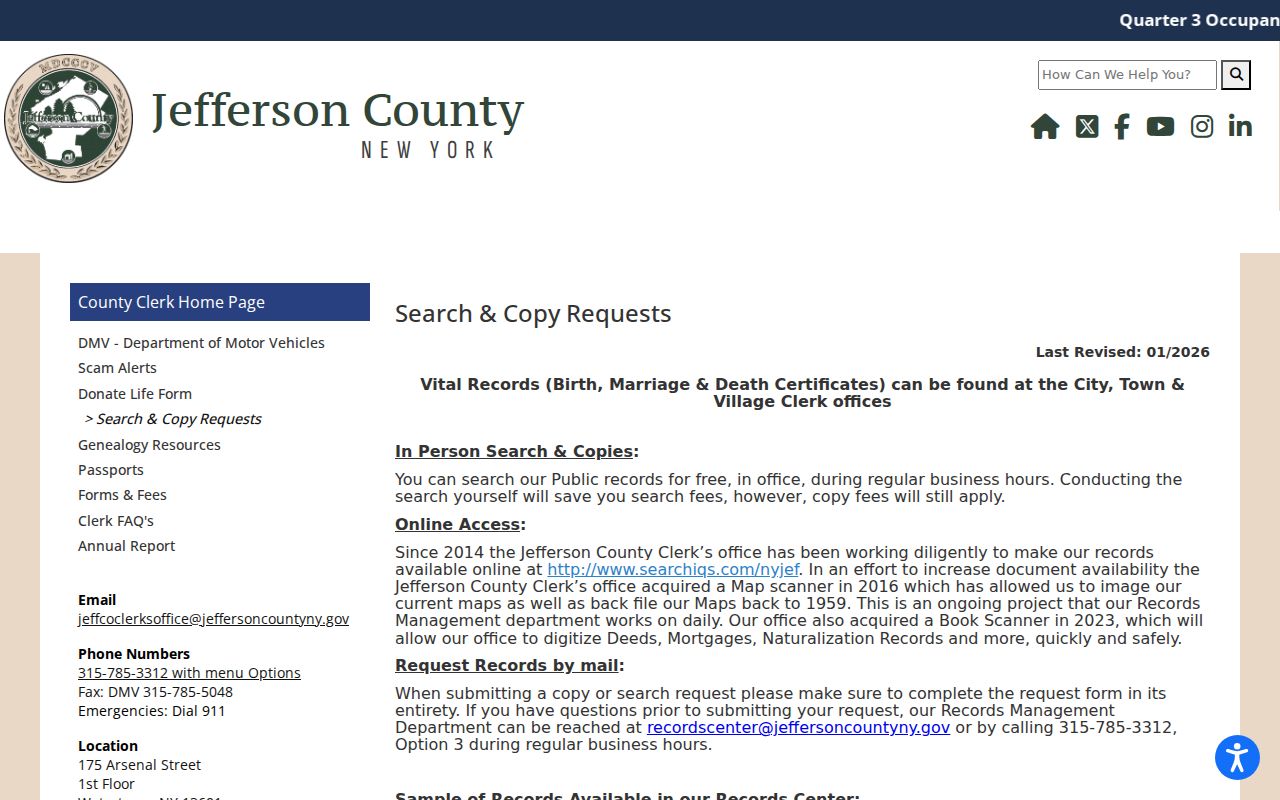
The Clerk's search route leads to the instrument that separates recorded consideration from a roll value. Not every deed reflects the open market. Family transfers, nominal amounts, partial interests, estate deeds, corrections, and unusual instruments can all distort the figure. Read deed type, parties, date, and consideration language.
Compare Jefferson County Sales Responsibly
A good comparable shares the municipality and property class. It also shares general context and a nearby sale period, so keep the sources aligned. The assessment parcel, deed, and sales-report row should describe the same transaction, and a City statistic should not sit beside a rural parcel without explanation.
| Comparison control | Why it matters | Record to retain |
|---|---|---|
| Municipality and SWIS | Assessment practices and ratios can differ | Roll heading and parcel key |
| Property class | Use and building type affect comparison | Class code and description |
| Sale date and instrument | Market period and transaction type matter | Deed and sales-report entry |
| Parcel size and map context | Land configuration affects relevance | Roll, GIS, and recorded map |
| Assessment date | Roll value may predate the sale | Applicable annual roll |
A comparison supports your research, but it never substitutes for a professional appraisal and should not be dressed up as one.
Exemptions and Taxable Value Differences
Exemptions can move taxable values while the assessed value stays put. County, municipal, and school taxable columns may differ. Read each labeled column on its own terms. Never collapse them into one number.
An exemption proves nothing private about an owner. Eligibility, renewal, ownership, residency, and filing rules belong to the current official program and the assessor. The detailed calendar, tax bill, and review process sit in the property-tax workflow, not the value fields.
Compare years with care. A change may come from reassessment, exemption status, a parcel change, a correction, or a different equalization relationship. A higher taxable figure does not mean the tax bill rose by the same share.
Why Jefferson County Values Change by Date
The assessment calendar moves in steps. It separates the valuation date, the taxable-status date, the tentative roll, the grievance period, and the final roll. A sale can close after the valuation date. A deed can also be recorded after taxable status is set. So a final roll can easily coexist with a newer owner of record or a fresher transaction sitting in another county system.
City Image Mate updates its owner and sales data daily. The data reflects deeds filed within three working days. That pace is City-specific. It does not turn the annual City tax roll into a live record. County and town owner-refresh timing has no single stated number.
Order the dates before comparing anything. Sort the valuation, sale, recording, roll, and access dates into one timeline. Many apparent conflicts simply vanish once that order is visible.
Citywide Watertown Values Are Not Parcel Appraisals
Census QuickFacts puts the 2020-2024 median owner-occupied housing value at $158,600. That median covers the City of Watertown. The owner-occupied housing rate is 40.9 percent. Those are citywide Census measures. They are not an assessment or an appraisal of any particular parcel.
No official material supports naming one fastest-appreciating neighborhood. A careful trend study would compare dated City full-market fields and compatible sales reports. It would also weigh property classes and broader Census context. Downtown and Public Square carry redevelopment and historic-investment context through the DRI plan. That context is still not a forecast for any single property value.
Northside, Sand Flats, Downtown, Sherman, Ohio, and Knickerbocker are planning neighborhoods. They work well as geographic context. Treat them that way, not as automatically recorded subdivisions or guaranteed market segments.
Historic Features and Jefferson County Property Value
A historic designation can enrich property records research. So can a notable building, an old address, or a neighborhood story. But public historical sources do not calculate a sale value. Watertown's Public Square and Trinity Episcopal Church carry rich official context. So do Paddock Mansion, Flower Memorial Library, and the Paddock Arcade. Other mapped downtown places carry it too.
National Register status alone proves nothing about ownership, zoning, a tax exemption, or permit restrictions. For present land-use questions, use City planning and zoning sources. For ownership, use County Clerk deed records. For a valuation opinion, hire a qualified appraiser. The 1907 address change may be needed to tie historical evidence to the right present parcel. The 1908 directory may also help match the parcel number.
What a Jefferson County Property Value Does Not Tell You
A public value reveals no guaranteed asking price, offer price, lending value, replacement cost, tax payoff, title condition, or surveyed acreage. Full-market value is not automatically what a willing buyer paid. A single recorded sale in the deed records may not represent ordinary market conditions at all.
Value limit. Jefferson County assessed value is used in the assessment system; it is not a current appraisal or promise of what the property would sell for.
For an important decision, keep the official roll and deed, confirm the parcel and dates, and obtain the professional product the purpose demands. Use public owner of record and value information lawfully. Never use it to harass, shame, threaten, or target a person.